Today was the most exhausting day so far. The morning began with a lecture from Professor Kolodka about what dyneema is and why it’s special. He explained that it is the second strongest fiber in the world right under zylon and is produced by a specialized gel-spinning process that perfectly aligns millions polymers perfectly parallel to each other, thus giving the fiber its outstanding strength. The application of nylon that stood out the most to me was in motorcycle denim. Apparently, dyneema is extremely light and has a low coefficient of friction, and because it’s so strong, manufacturers can leave gaps between the woven fibers to make the material more breathable. These characteristics not only make the material desirable to wear, but they also offer better protection for motorcycle riders in cases of wipeouts because they will slide a further distance, thus allowing the riders’ kinetic energies to dissipate slower and for them to experience less severe friction burns.
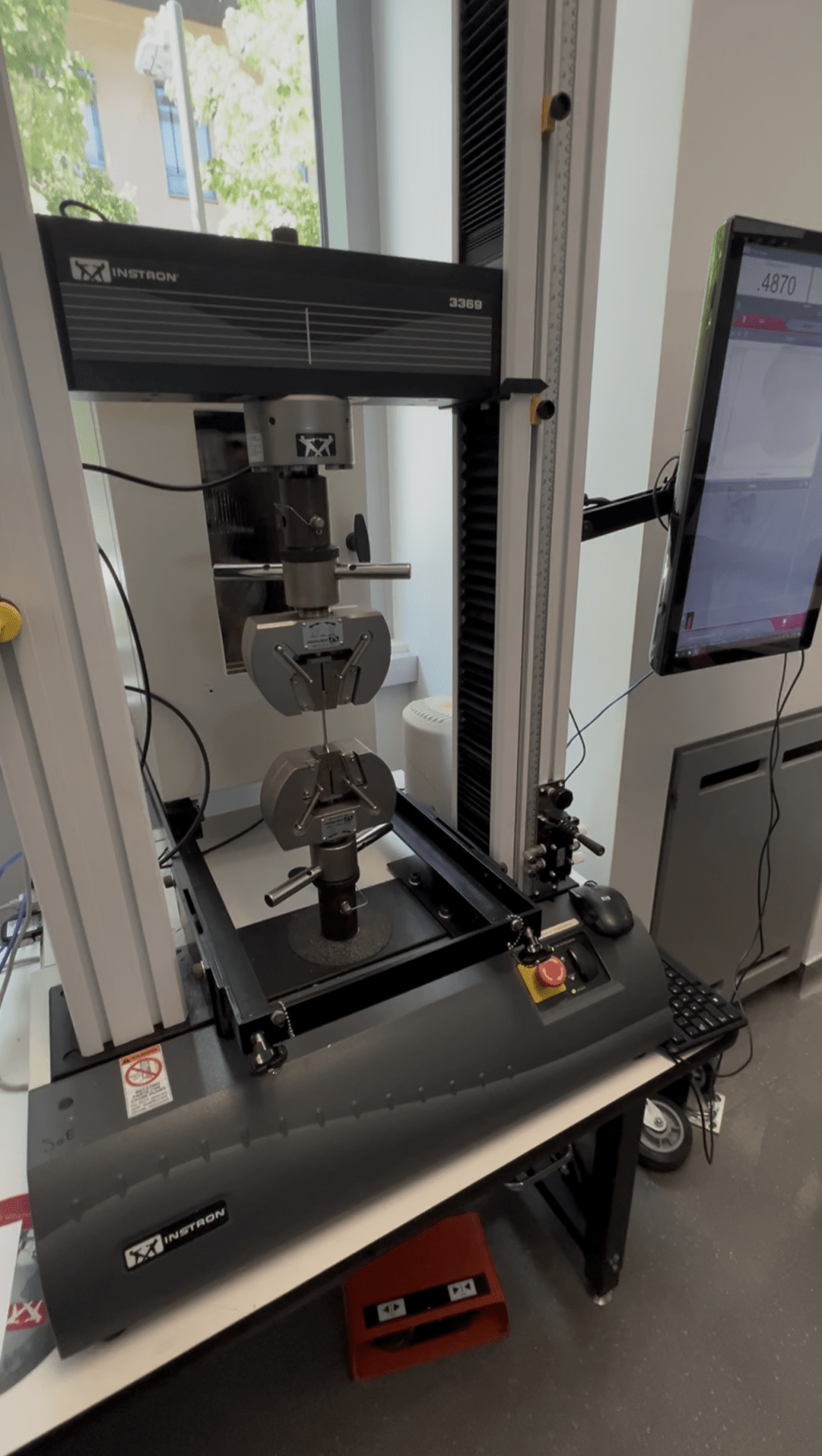
Professor Kolodka also spoke about tensile testing, which we later got to try in the afternoon lab session. Tensile testing is an experimental procedure in which a material sample is stretched until it breaks. Today, we were given samples of 5052 H32 aluminum and an unknown type of steel (producers’ error because they weren’t sure which type that they had sent), and we were tasked to use an Instron (a tensile testing machine) to plot graphs the force exerted on the samples versus the displacement of the machine, then to use these graphs to calculate the yield stress (the maximum stress a material can endure before entering the state of plastic behavior), ultimate tensile strength, strain, and Young modulus for each type of metal. After hours of calculations, no one was able to solve for any of the expected values, but every group’s calculations came to the conclusion that the steel was significantly stronger than the aluminum.
At the end of the lab session, Professor Kolodka said something that really hit close to home. He said that as scientists, when we perform calculations, we are always going to encounter some variability, but we must keep repeating the procedure until the average reaches as close as we can to the expected value. At first, I rejected this idea because it sounded absolutely insane. What if I quite literally never reach the expected value? When am I supposed to know when to stop?
However, now that I think about it a bit more, I realize that this idea extends beyond the lab and teaches a lesson of perseverance and knowing when to be content. In the lab, you shouldn’t just trust the first measurement because there could be too many factors that led to your answer deviating from the expected value. However, you shouldn’t waste the rest of your life repeating the same calculation. Not only would you not accomplish anything, but you would also waste a lot of resources. Similarly, you shouldn’t give up on a goal after your first attempt, but you also shouldn’t stick with it to the point that you sacrifice your health and wellbeing.


Leave a Reply