I knew beforehand that material science was interdisciplinary, but today felt entirely like a biology class. Roberto’s final lecture was about biomaterials, which he defined as substances engineered to interact with biological systems for a medical purpose, whether it be therapeutic (treating a disease, recovering a lost function) or diagnostic (identifying a malfunction). He particularly focused on joint replacements, the mechanics of the knee, and, what i found most interesting, fluorescence-guided surgery (FGS), also known as lymphatic mapping.
FGS is a surgical technique used to identify cancerous tumors. It involves injecting fluorescent chemicals, typically indocyanine green, directly into the bloodstream and using specialized surgical cameras to observe the reaction. The dyes accumulate in target tissues and emit green wavelengths that excite other areas to emit red wavelengths, thus creating a distinct image compared to one created by healthy tissue. Based on the image created, surgeons can determine whether the tissue is healthy or cancerous. I wonder what characteristics of the tumor cells cause them to emit different images from healthy tissue?
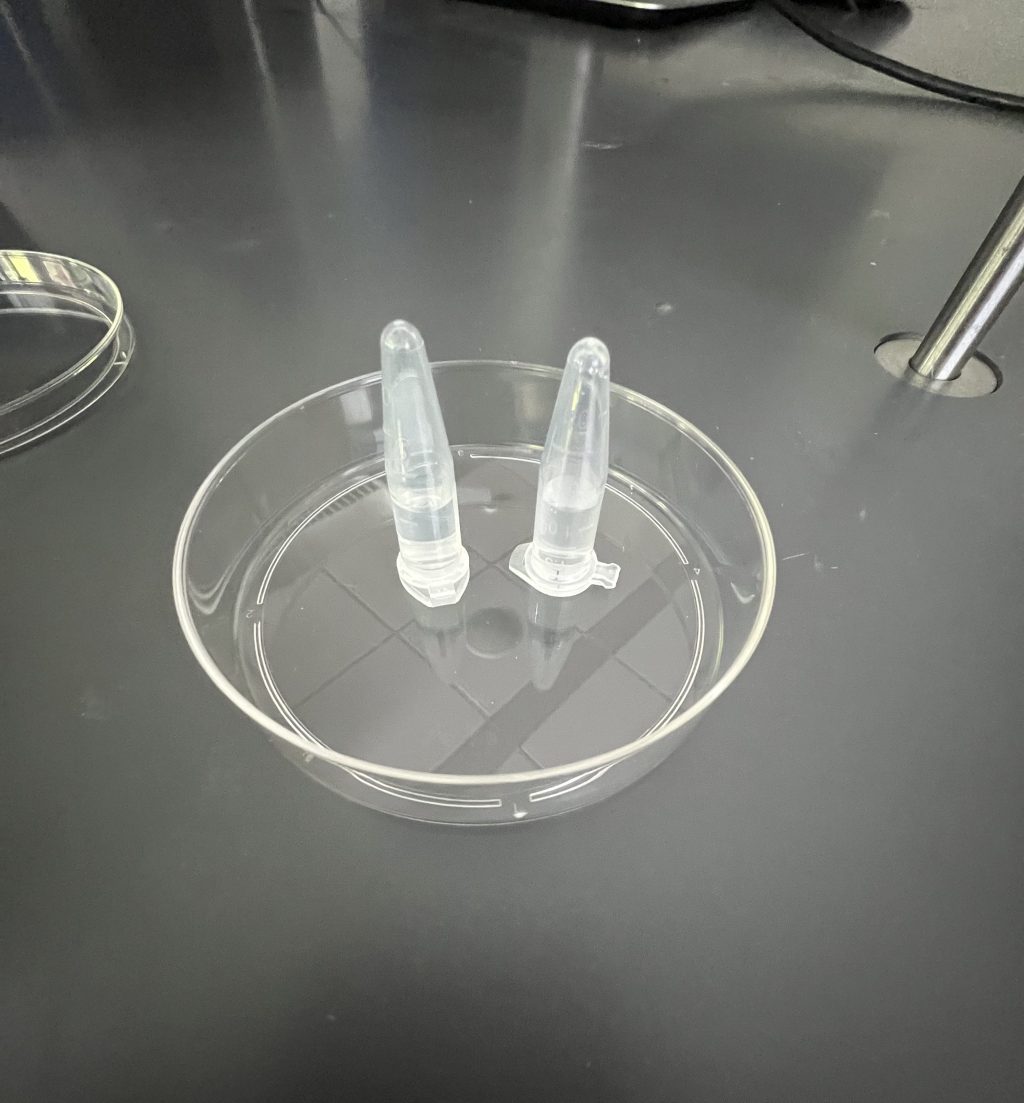
Our lab for today felt more materials-focused. We were tasked to make two different hydrogels and to compare their Young’s modulus by putting them under a known strain and measuring the deformation caused. I learned that hydrogels are 3D networks of cross-linked polymers that are very hydrophilic, and depending on the cross-link density, the hydrogel will have different absorption levels (higher cross-link density = smaller pores = less absorption, lower cross-link density = larger pores = more absorption). Unfortunately, we mismeasured some of the liquids that we were supposed to add, so the hydrogel was not able to form. When we went to the process after the other groups had gone, we ran out of one of the two catalysts needed for the cross-linking to occur, so we decided to double the dose of the second catalyst as advised by Roberto, but that didn’t work either, and we weren’t able to form the hydrogels to complete the lab.
This experience highlighted the lesson of carefulness that the cyanotype printing lab should’ve taught me. Even though I was able to get away with my carelessness last time, that was not the case with this experiment, as I didn’t even get to properly participate in it.


Leave a Reply