This week’s focus is on polymers, so Professor Kolodka gave us a brief introduction on what exactly polymers are and the ways that they’re produced and categorized.
Polymers are long chains of smaller repeating units called monomers, and they can be naturally occurring (ex. proteins), synthetically produced (ex. polyethylene), or chemically modified versions of natural ones (ex. cellulose acetate). Synthetic polymers are traditionally produced in two ways: condensation (where one water molecule is lost in the bonding of two molecules to form the monomer) and addition (where two molecules are combined by breaking carbon-carbon double bonds into single bonds, but no atoms nor molecules are lost).
Professor Kolodka also defined two main categories of polymers: thermosets and thermoplastics. Thermosets are polymers that burn up rather than melt and become malleable when heated after they’ve already been shaped and cured, while thermoplastics can be continuously melted and reshaped. I was surprised to learn that over time a thermoplastic will begin to sag under its own weight, a concept that is called creep, which explains why things that need to retain their structure for long periods of time, especially ones that are often exposed to heat, are made of thermosets rather than thermoplastics.
The most fascinating behavior of polymers that we learned about was the Weissenberg Effect, which is a polymer’s ability to climb up a rapidly spinning vertical rod. Professor Kolodka explained that polymers have many chain entanglements and that the spinning rod lines up the entanglements of the polymers in its immediate vicinity. However, the polymer doesn’t want its entanglements to be lined up, so more of the polymer tries to climb up the rod and become tangled again. Additionally, some polymers become more aligned than others when they’re spun, which allows them to climb further up the spinning rod.
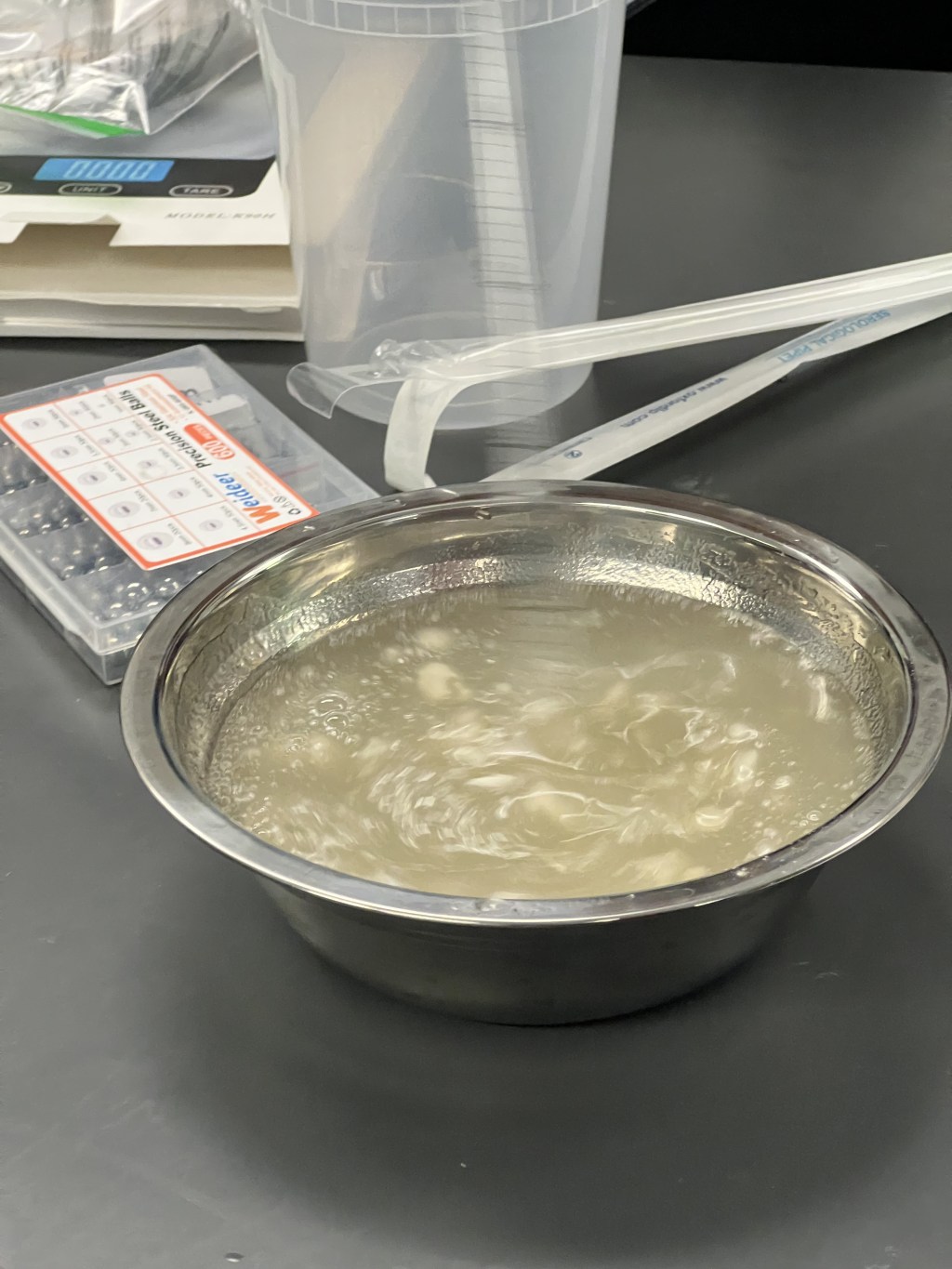
The lab in the afternoon focused on a different strange behavior of polymers: their non-Newtonian flow, which means that their viscosities change depending on the force applied rather than remaining constant. The lab involved creating guar-gum-water solutions of varying concentrations, dropping small spheres of various materials (and therefore different densities) into the solutions, and calculating the terminal velocities of the spheres as they fall through the solutions in order to calculate the viscosity of each solution. While it was obvious that adding more guar gum increased the viscosity of the solution, but my question is why does such a small difference (0.5 wt%) make such a noticeable impact, even to the naked eye? What about the guar gum makes it so hydrophilic?


Leave a Reply