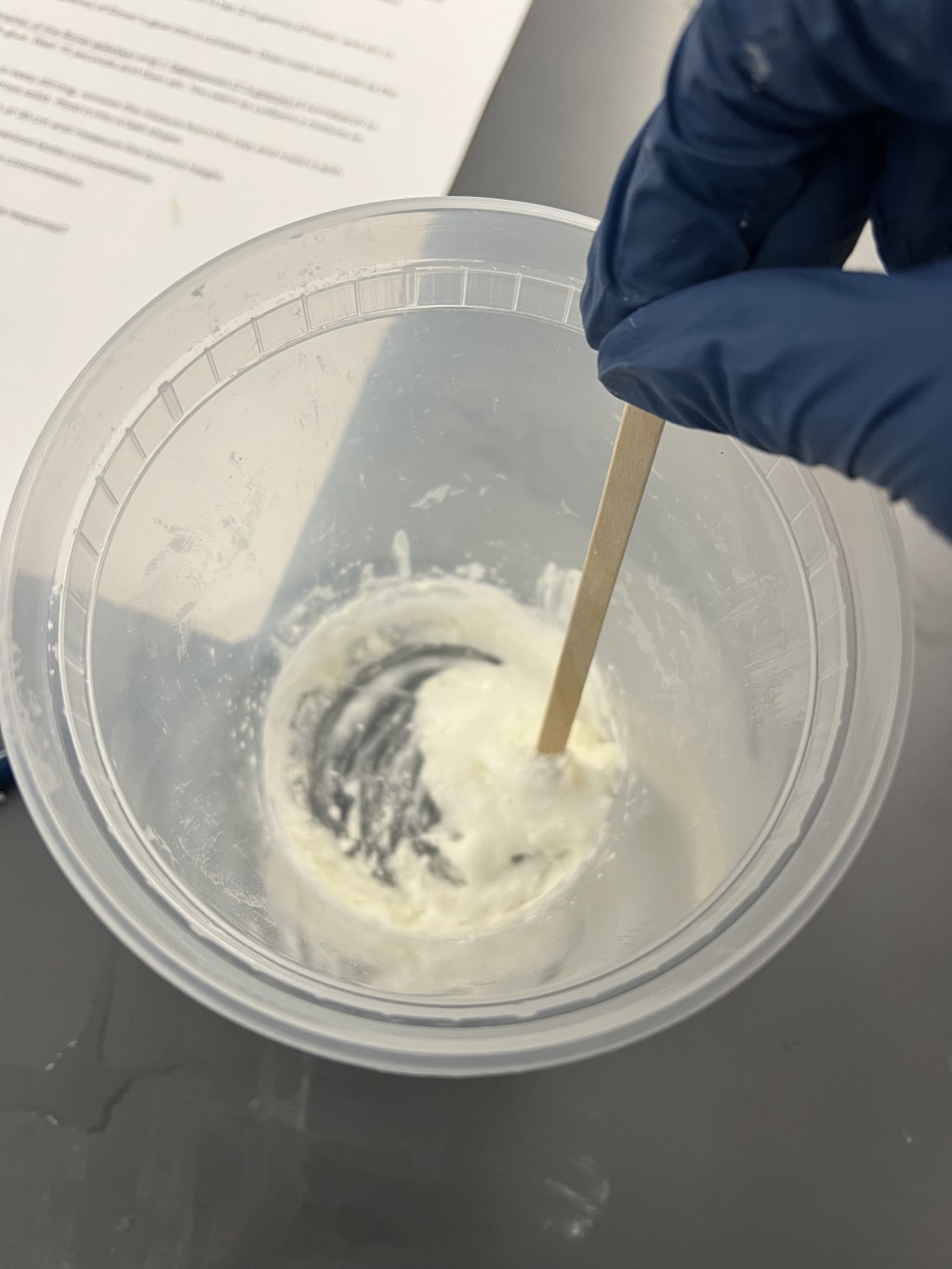
Today’s lab time was super jam-packed with two experiments in one session. Our first lab was about the effect of cross-linking density on the bounciness of rubber balls. We achieved different cross-linking densities by mixing 15 grams of Elmer’s glue and 7.5 grams of corn starch with 2.5 grams of borax-solutions of varying borax concentrations. Mixing these ingredients with a stir stick eventually created a large white clump that we used our hands to massage into the shape of a ball. Then, we dropped each ball three times from a meter above the ground and measured the height of the first bounce. As I had predicted, the bounce heights created a sort of bell curve as the concentration of borax increased. If we didn’t add enough borax, the polyvinyl acetate (PVA) wouldn’t cross-link enough to form a proper ball, but if we added too much borax, the PVA would cross-link too much and form a substance too stiff to be shaped into a proper ball as well. Theoretically, though, the results that we produced don’t seem quite right. Shouldn’t a harder, stronger substance be able to bounce higher?
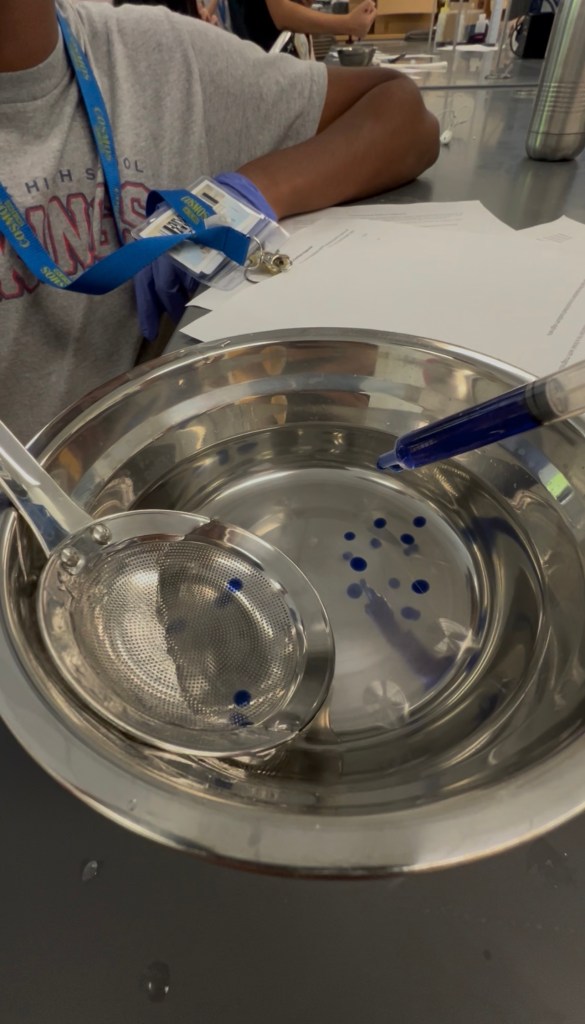
The second experiment was the long-awaited popping boba lab! However, we weren’t able to eat the pearls that we made because we weren’t following proper food sanitation/safety practices. We first mixed 250 grams of distilled water with 2 grams of sodium alginate, and this solution would be shared amongst the whole class. Next, each group of four mixed tap water and calcium lactate in a 100:1 ratio. Then, one person from each group filled a syringe with the sodium alginate solution and dispensed it drop by drop into the calcium lactate solution. When a drop of the sodium alginate solution fell into the calcium lactate solution, the positive calcium ions reacted with the polymer chains in the sodium alginate and caused them to cross-link, thus forming the thin, easy-to-pop spheres that we know as popping boba.


Leave a Reply