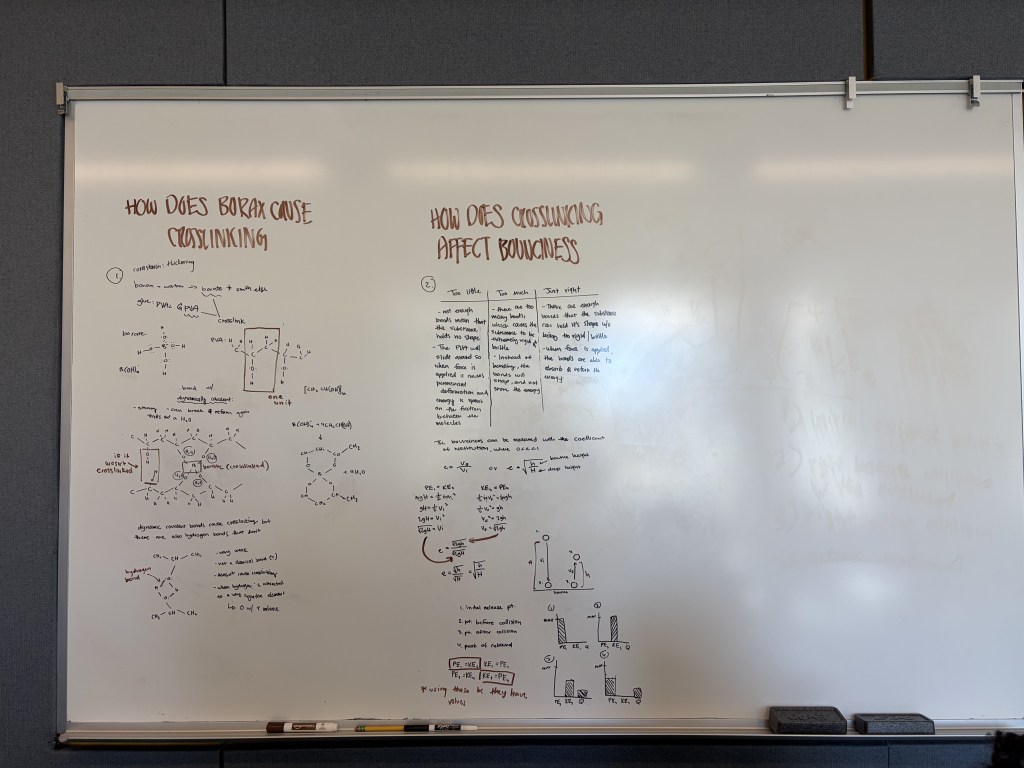
Today, my group and I sought out to find the relationship between cross-linking density and bounciness. First, though, we had to find a way to even measure the bounciness.
A quick Google Search told us to use the coefficient of restitution as our metric, which we learned was the ratio of an object’s speed after colliding with the ground to its speed before collision. However, we didn’t do any calculations for velocity, and we didn’t take the mass of each ball, so we wanted to find a formula that used final and initial heights instead. Some further digging on YouTube gave us our solution: with some clever manipulation of the formulas for kinetic energy and gravitational potential energy, we could prove that the coefficient of restitution is equal to the square root of the ratio of the ball’s final height to its initial height.
Now that we had a metric for bounciness, we had to find the relationship between cross-linking and bounciness. Although our data seemed to support the idea that cross-linking was directly related to bounciness, this conclusion didn’t sit right with us. Something as hard as a rock simply isn’t going to bounce as high as a more elastic material is. There had to be an optimal amount of cross-linking, and anything exceeding that threshold would result in decreasing bounciness. Since on Friday Professor Kolodka promised us more project work time tomorrow, we ultimately decided to continue testing with borax-water weight ratios closer to 1:3 to hopefully collect data that supported our hypothesis.


Leave a Reply